Category Archives: Innovations
Get unstuck – NOW
Do you feel as if your organization has gone stagnant? Have you been engaged in frenetic activity to increase donations,but the results have been less than you’d hoped? Have you not had the success you desired on grants or major gifts? Are you tired of blaming the “bad economy”?
An organization, like a person, can get in a rut: the message goes stale, inefficiencies crop up, funding dynamics shift downward and relationships aren’t working. Years of observation and experience have shown me that often it takes only one or two small changes to make tremendous impact and shift the forward/upward momentum.
Getting Unstuck:
The first step in the process with my clients is to conduct a Current Reality Assessment. In this step of the process, clients receive a comprehensive review of 8 areas of the organization to get a “where we are now” picture. The client provides the requested information, and we produce a report that makes observations and recommendation for action. The focus is on ways the organization can improve so as to become more attractive to potential donors. The emphasis is on making it possible to get more funding in the door.
Knowing that especially smaller non-profits may be in a near-desparate position right now, I am making an offer to help your non-profit get “unstuck” and shift that momentum. Organizations that sign up by June 10, 2011 will receive a comprehensive Current Reality Assessment for a deeply-discounted rate: $500 (normally $1750). 3rd party reviews of grant proposals/grant requests are available for $200 per proposal (again – must sign up by June 10, 2011)
These are pre-paid, non-refundable services. It is designed to give you an unbiased perspective and perhaps expose some blindspots that could make an enormous difference for your organization. Most important, you will have definitive first-step actions that you can take immediately to get you what you want.
If you are interested in the observations and recommendations of an outside observer with experience in philanthropic endeavors, contact us at: 614.524.4264. You may also email us at PhilanthropyPlus@hotmail.com
Advancement model aims to better engage ‘OSU family’
Advancement model aims to better engage ‘OSU family’
Advancement – it’s about promotion, passion, aspirations. When every one in your organization is speaking with one voice, then the message to the outside world is clear. What you find is that as you connect and tell the story, you don’t have to “make the ask”. Instead, you will find that the potential donor gets excited as well and “makes the ask” with the question: How can I help? How can I be part of this?
OSU is often my model to other organizations on how to promote themselves and attract/acquire the resources that will help them grow and advance into the future. Contact me to learn more about how the best methods in fundraising and advancement can be applied to your non-profit, no matter the size.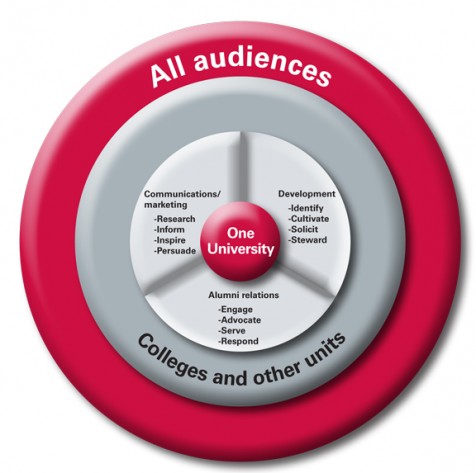
Confidence & Optimism at All-Time Low
I saw this on MSN.com today – from an NBC/Wall Street Journal Poll:
. . . 61 % say the United States is headed in the wrong direction; 65 % believe the nation is in a state of decline; and 66 % say they’re not confident that life for their children’s generation will be better than it is now.
In addition, Americans are deeply pessimistic about the state of the economy. Only 26 % think the economy will improve in the next 12 months (which is down 14 points from the previous poll), and just 26 % believe their wages will increase in the next year.
Confidence in key U.S. institutions is also incredibly low: 18 % have confidence in the federal government; 13 % have confidence in the news media; 12 % have confidence in large corporations; 10 % have confidence in the financial industry; and only 9 % have confidence in Congress. The numbers for the media and Congress are the lowest for those institutions in the entire history of the poll.
What are the implications for philanthropy?
If you are a non-profit, what does this poll tell you? What do you have to do differently? What does it mean for the future of your organization and those you serve?
If you are a philanthropist (donor) – of ANY size net worth – what are the implications for you? How do you feel about the future of the American/World economy? How do you feel about your family’s future? What would you like to do about it?
SEEKING: non-profits that you know and love that are in looking to improve their revenue streams. Contact Laura Anne Miller, 614.915.4324, lmiller@nfpcoaching.com today.
Full story on msn.com http://www.msnbc.msn.com/id/38996574/ns/politics/?GT1=43001
Marketing Idea No. 215 – What we can learn from Bill Murray and Groundhog Day (via Creating the Longest Marketing Idea Chain in the World)
Check out the article link below from the “idea chain” blog
 focus on your strengths – keep doing what does work and do more of it – STOP doing what doesn’t work! How does this apply to your non-profit? What unworkable activity do you keep trying, hoping for different results? Post your comments below . . .
$41,000,000,000,000
That’s read: $41 trillion
What is this number?
It is the estimated amount of wealth transfer from one generation to the another in the next 50 years. Most non-profits are salivating at that figure -anticipating that it is going to come to them. But most of these organizations are kidding themselves. Why? Because they are not planning to channel those funds to the social sector – they are pinning all their hopes on it just coming to them because people realize they are in pursuit of a noble cause.
In reality, most non-profits are so focused on events, direct mail and corporate sponsorships (i.e., annual fundraising) that they are losing sight of the fact that this $41 trillion will slip past them and go right to federal and state coffers. They are so concerned about their short-term urgency that they are setting themselves up to be in “urgent” mode in perpetuity.
MYTH: Your current individual donors are so in love with your organization that they will just naturally leave you their wealth.
REALITY:
- Most donors are not aware of philanthropic vehicles beyond a will bequest – which in many ways is the least beneficial of all planned giving techniques (for them, their families, and the non-profits they remember in their wills).
- Will bequests often are seen as a “windfall” to the non-profit organization. It comes as a 1-time surprise. There is no systematic, purposeful plan to include legacy funds in the long-term revenue mix.
A well-organized planned giving program can keep the doors open now and in the future. It is not an either/or situation. One of the key features of PhilanthropyPlus ™ is that it is pays for itself right away and along the way. It builds a steadily rising stream of income that is predictable and based in relationships – not annual transactions. PhilanthropyPlus ™ takes a shift in processes in fundraising and development; but it is one that can be implemented in less time, at lower cost, and with less frustration than you may think.
Check out the Interpretations Advisor Group website to learn more and to contact Laura Anne Miller to discuss how PhilanthropyPlus ™ can be a planned strategy for growth.
You can make only so many budget cuts before you disappear.
Non-profits with an active planned giving program are more stable than those without one.
Last year, when the recession really hit, most non-profits tightened their belts. Then they went on a binge of events, galas, direct mail appeals and “tin cup” campaigns (the least effective methods of fundraising, by the way.)
Well, revenues for most non-profits were down anywhere from 10% – 25%, or worse. If an organization made budget cuts last year, there is no more “fat” left to trim. They could shut their doors if they don’t find a way to raise more revenue, and raise it now. It may seem like a hopeless downward spiral, fraught with stress and confusion. So what is a non-profit to do?
A system of sincere, values-based, face-to-face encounters with donors and potential donors is the key to your success, both now and in the future. It will take a plan that includes not only annual fundraising but also planned giving.
The problem is that planned giving is complex. It is a mystery to most development professionals, let alone board members, executive directors and donors. Further, it takes a very long time to “convert” the donation – an average of 18 months to 3 years. Therefore, very few organizations have truly meaningful and effective planned giving programs.
However, the average size of a planned gift is 20-25 times larger than the average annual gift, including corporate sponsorships. In addition, organizations that have an established planned giving program are weathering the recession storm better than the average non-profit.
An investment in a planned giving program does not have to be delayed. With a fresh approach, such as PhilanthropyPlus ™, my clients can raise money now AND planet seeds for that future growth and security. Any plan to get a planned giving program up and running should include:
- CLEAR, values-based, compelling case for support
- Education & Professional Development for the non-profit leaders
- Board engagement and education
- Ambassadorship program
- A “sales” program of genuine relationship cultivation & referrals
It takes time, a lot of authentic character development, focus on service and discipline. In the process, you will have to get out of your “cave” and into circulation, which is very difficult for most non-profit professionals. It is not easy, like an event or a direct mail campaign, but it is simple.
For more information on how your organization can have PhilanthropyPlus ™ work for you, see our website and Laura’s full LinkedIn profile.
Non-profits working harder . . .
This news story came across my desk today:
Non-profits working harder/Donations still down
http://foundationcenter.org/pnd/news/story.jhtml?id=286000019
How are all those events working for you? – if you are like the organizations in this article/survey, probably not as well as you would like . . . and you are putting more time and effort into them.
Why work harder when you can work smarter to bring in revenue? PhilanthropyPlus has 2 “shovel ready” plans that are low/no cost ways to increase revenue now, and build meaningful realtionships in planned giving.
Did you know that Planned Gifts average about 20-25 times the size of the average annual gift? In addition, it solves a whole host of problems for small businesses, family-run enterprises, and high-net-worth families. But don’t be fooled – it takes an authentic person willing to focus on servicing the donor. It also takes time: about 18 months-3 years of CONSTANT cultivation before the gift is “official”.
So, in the meantime, you are under pressure to produce results NOW. That’s what the PhilanthropyPlus processes can do for you. Contact Laura Anne Miller to get started on a path that leads to an increasing stream of diversified revenue.
New Attitudes & Behaviors in Philanthropy
Check out this brief slide show on the paradigm shift in giving and some innovative ways to adapt.
This is for non-profit organizations and businesses that want to make philanthropy part of their business plan.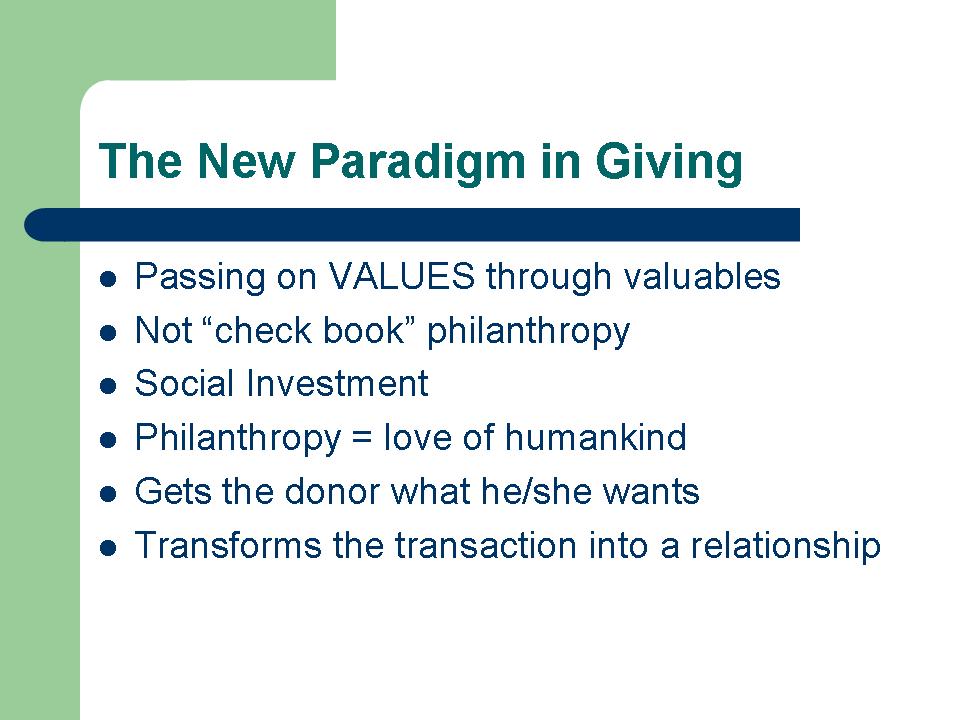
Paradigm Shift – Part 2
Here is a “David Letterman” List of the different methods of annual fundraising – from least effective to most effective. Source: Center for Philanthropy, Indiana University
* Media/Advertising
* “Door-to-Door”
*Special Event
*Impersonal telephone/telemarketing
*Telethon/Radiothon
*Impersonal letter/direct mail/internet
*Telephone solicitation – warmer prospects
*Personalized letter/direct mail/internet
*Personal letter/personal telephone call
*Face-to-face (transition to long-term)
Where are you spending your time? If you are not concentrating on getting the face-to-face, one-on-one conversations, you are going to be disappointed in your fundraising efforts. It doesn’t mean that you stop doing all the others, but you should be spending 80% of your time on the last 2 methods.
“But,” you exclaim, “I don’t have time to meet with all the people!”
Of course you don’t. That’s why you have to train effective ambassadors in a systematic, purposeful process. Create a referral network with the power to transform your fundraising. This system has worked for millions of individuals and businesses – it is a PROVEN process that gets people out of their caves and into the arena of advocacy. See www.nfpcoaching.com for more information on PhilanthropyPlus and how you can get those face-to-face meetings!
Paradigm Shift
The Paradigm has already shifted –
It is clear that for non-profits to succeed and make a difference in our world, some attitudes, behaviors, and methods have to change immediately. We do not want to repeat 2009.
The Chronicle of Philanthropy reported last autumn that 74% of donors surveyed said they were waiting for the economy to improve before they return to higher levels of philanthropic giving. And things don’t look as if they are going to become better for a while.
So, you wait and wait and wait.
But can you really afford to wait for outside circumstances to change?
To put a finer point on it –
- Can those you serve, or could serve, afford for you to wait until you feel ready?
- What is the cost to humankind for your delay?
- Who suffers while you hesitate or keep “trying” the same old fundraising and management methods that have ceased to work?
It is obvious that you will have to be proactive in your innovations in 2010. But where do you start? What is the process of finding and creating those innovations? That’s why I have created PhilanthropyPlus ™ . It is a turn-key system that allows non-profits to operate in the most effective areas of management and fundraising. It provides for immediate improvement while planting the seeds for long-term sustainability.
 Unleashed Abundance