Nine Things Successful People Do Differently – Heidi Grant Halvorson – Harvard Business Review
Nine Things Successful People Do Differently – Heidi Grant Halvorson – Harvard Business Review.
 Want to develop “success” habits? Read this HBR article and check out joining a MasterMind group today ~ http://Ez.com/lauraA
Special BONUS offer for non-profit staff and board members! Call 614-915-4324 or email philanthropyplus@hotmail.com
PLUS – a corporate MasterMind and Philanthropy program that can change the way you do business . . .
Contact Laura for more information – 614-915-4324 or philanthropyplus@hotmail.com
Purposeful Action
Over the last few weeks on our internet radio show, Making Good Work, we have spoken with two dynamic people working in philanthropy. Barbara Brown is on the non-profit, fundraising side while Laura Malone works from the donor and donor advisor side of the equation. They each gave us great insight into the New Paradigm in Giving and how we can be more effective in the modern age of philanthropy.
Laura Malone, of the American Endowment Foundation pointed out that major philanthropists of today are looking to make an “investment”. They are looking closely at non-profits in the same way that they evaluate and select a venture capital investment. They have a network of trusted advisors that help them structure their philanthropic portfolio to leverage dollars and benefits to the maximum advantage for all involved.
So, she advises that non-profits make sure that their structure is sound so that they can make a compelling case for support. Her practical advice is that non-profits of all missions and all sizes reach out and engage the trusted advisors in a more meaningful way. She also spoke about the non-profit being a sincere “giver” to the donor, without expectation of anything in return. She knows from personal experience how this generates meaningful contributions for many organizations at once.
Barbara Brown described how to build a network of supporters – even when you are a small non-profit that is just starting out. By systematically talking with people about the mission and asking for referrals, she was able to gain introduction to those whose values match the mission and are dedicated to making it a reality. In the beginning, she knew only a handful of people that were interested in the project. Nevertheless, she passionately implemented a disciplined two-year program that led her to build a database of over 1600 “raving fans”.
These two people show us the imperative of doing things differently. Even if your organization is not ready to launch a major gifts program or cultivate planned giving, you can still work in the most effective areas of annual fundraising – face-to-face conversations. These are the exact skills you will use in gaining the gifts that are 20x-25x larger than the annual gifts when you are ready to venture into planned giving.
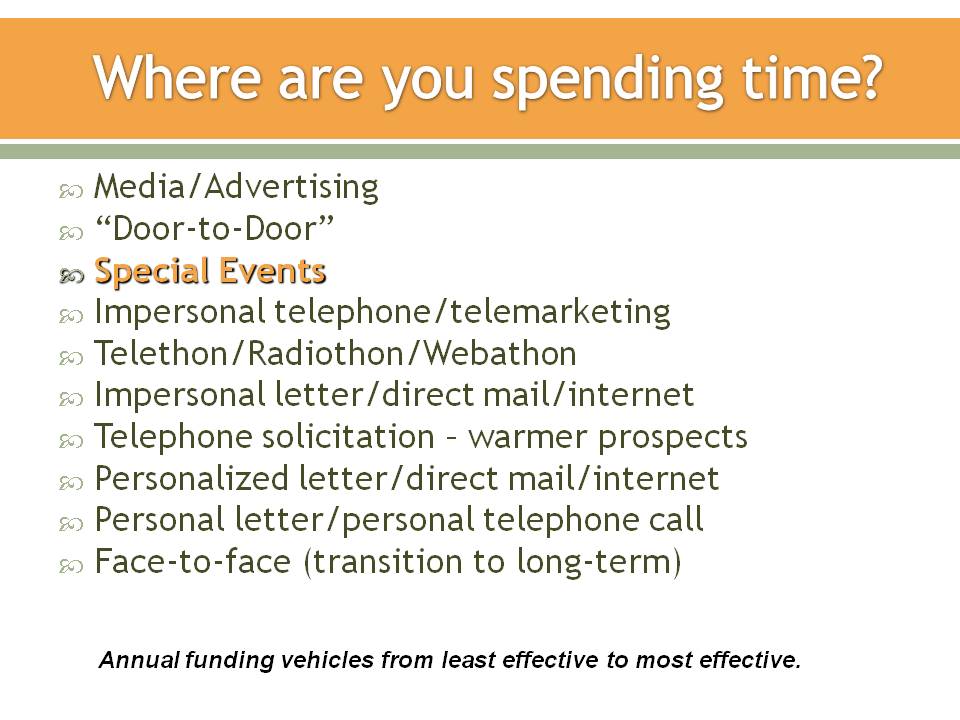
Efficiency is doing the job right. Effectiveness is doing the right job. – Rick Gettle
Review the list – are you doing the right job to accomplish the goal of more revenue?
So, the first step for even small organizations is to concentrate on raising more annual funds in less time and with less effort. In other words, be more productive and build more solid relationships that will lead to more substantial gifts. Educate yourselves about people (in general and individually) and learn about all the different ways philanthropy can meet their needs.
It is a simple plan, but it is not easy. It takes an individual commitment to improve personal performance as well as a willingness to talk with people in private conversations. It takes energy to leave the office and press the flesh and ask for referrals. It takes courage to risk doing something that you have never done before – courage to persuade your boss and your board that it makes sense . . .
Action List to improve performance and increase revenue:
- Define exactly what you want – write out your specific goals every day and link your schedule to those goals
- Educate yourself every week on something new to help reach those goals
- Surround yourself with like-minded people that can give you fresh ideas and inspiration toward achieving your goals.
- Re-design your strategy and priorities to include more one-to-one conversations
- Review your donor lists and begin learning MORE about each individual
- Reach out to estate attorneys, financial professionals, CPAs and life insurance professionals.
5. Find an accountability partner to help you and whom you can help
Laura Miller has a Mastermind program that will help you accomplish this Action List.
Contact her at philanthropyplus@hotmail.com or 614-915-4324.
Heard on the Web: Charitable Lead Trusts Draw Renewed Interest

- Jackie O. had a CLT, but it’s not just for the uber-wealthy

Our guest on the “Making Good Work” radio show for Wednesday is Laura Malone. In the interview, she will give an example of how a family is using a Charitable Lead Trust with a DAF to maximize the positive impact of donations – now AND in the future.
If you don’t know about Charitable Lead Trusts, how they can help your organization’s current budget, and why this may be an option for many of your donors, click to link on this article from the Planned Giving Design Center.
Heard on the Web: Charitable Lead Trusts Draw Renewed Interest.
Want to learn more? Contact Laura for a discussion on ways to expand and diversify your revenue stream – no matter the economic climate.
614-915-4324 (USA)
Making Good Work 08/31 by PhilanthropyPlus | Blog Talk Radio
 Making Good Work 08/31 by PhilanthropyPlus | Blog Talk Radio.
Laura Malone of American Endowment Foundation joins us this week for a discussion on being truly “donor-centered”. The ideas she will share with us will challenge you to rethink your current plans and strategies for fundraising now and in the future.
Join us!
Radio Program for This Week

There was no show this week – your host, Laura Anne Miller, is also a busy mom with 5 children, and today was the first day of school! Listen to an archived episode and join us NEXT WEDNESDAY August 31 at 2pm. Thanks!
We All Want the Same Things
If you are visiting this page, then it is likely that you are at a place in your life where:
-
You want to be successful in your chosen field
- You want to make a positive difference
- You want to leverage the most of your time, money and talents
- You want to develop new skills to become more productive
- You want to be connected with like-minded people
- You want to be more – for yourself, your family and your organization
Most of you visiting this page also:
-
Have at least one relationship in your organization that is an obstacle to growth
- Are facing revenue and budget issues that threaten your organization’s existence
- Have been hanging on to processes and paradigms that have ceased to work
- Are looking for a miracle to happen . . .
I am here to remind you that YOU are the miracle you have been waiting for: You have unlimited potential. You can be, do and have anything you imagine and desire. That goes for your organization as well.
However, it takes definite, clear plans and the discipline to pursue your goals with relentless persistence.
It also takes the courage to:
- Abandon what has ceased to work
- Embrace new methods of working and raising funds
- Admit that you need to learn more than what you now know
- Ask for collaborative and supportive assistance from others
That is why we are forming MasterMind Groups for non-profit organizations.
What do you experience in MasterMind Groups?
-
Support – from your entire team and accountabilty partner
- Revenue – improve your financial condition from new knowledge
- Happiness – in all relationships and help others to be happy as well
- Long-term change – lasting, positive habits that are continually reinforced
- Better ideas – through teamwork and people who care
- Purpose – clarity of purpose + people to share it with
- Direction– design a clear path of your journey and next steps
And how does it work?
-
Napoleon Hill’s principles and proven System of Success
- Total portfolio of non-profit fundraising tools across an endless array of donor scenarios
- Training and education that doesn’t fade away
- One weekly meeting of one hour
- Intimate groups of 6 people
- Everyone commits
- Everyone has a partner
- Everyone participates
- Online from your home or office
What do you have when participating in an on-going MasterMind Group?
-
Success in your chosen field
- Making a positive difference
- Leveraging the most from your time, money, and talents
- Development of new skills to become more productive
- Connection with like-minded people
- Being more – for yourself, your family and your organization
I know that these statements are true from personal experience and work in a mastermind group myself.
If you feel that you can’t afford it or don’t have time to pursue this, I urge you to think beyond those objections. In my case, I have 5 children and I doubt that anyone reading this has less in their bank account than I did when I began working with a MasterMind team.
The real questions are– how are you choosing to spend your time and money? If you want to be more successful in your endeavors, what are you willing to risk in terms of time and money to make it happen? Asked another way – how badly do you want those things we described above?
If you are in non-profit work of any kind, you owe it to your organization and to yourself to investigate further and discover what needs and desires a MasterMind Group can meet in your life. Check out the MASTERMIND tab of this blog. Listen to the weekly radio show (see the RADIO tab of this blog), and give us a call to ask more questions.
Laura Anne Miller – 614-915-4324
Making Good Work Online Radio by PhilanthropyPlus | Blog Talk Radio
Making Good Work Online Radio by PhilanthropyPlus | Blog Talk Radio.
Wednesday, August 17, 2011 at 2pm Eastern Time (USA) –LISTEN NOW TO THE ARCHIVED EPISODE
The next episode is titled: Thriving in Times Like These , with our guest Barbara Brown of Cristo Rey Columbus. You will want to tune in to learn how this successful “philanthropic entrepreneur” was able to persuade people to support a high school for under-served youth that had not even been built yet . . . Hear about her methods of successful fundraising – I’m sure you will find Barbara to be engaging and enlightening.

NEW paradigm in giving is actually OLD
The New Paradigm in Philanthropy – it’s really quite old.
In 1630, John Winthrop was sailing west to a new land, America. He was leaving England to build and lead a new community in a wilderness. He knew that it would be difficult and would take persistence to achieve the aim of creating a new type of society. So on the long journey across the Atlantic, he wrote a sermon addressing the ideas of independence and INTER-DEPENDENCE that would be necessary for all to succeed.
In Winthrop’s day, as in ours, he realized that to work for one’s self and one’s family was an important motivator in building community success. However, he saw peril and “shipwreck” of the local economy and the Massachusetts Bay Colony if the residents did not also work to support each other in mutual generosity . . .
From the conclusion of this sermon:
Now the only way to avoid this shipwreck, and to provide for our posterity, is to follow the counsel of Micah: to do justly, to love mercy, to walk humbly with our God.
For this end, we must be knit together, in this work, as one man.
We must entertain each other in brotherly affection.
We must be willing to abridge ourselves of our superfluities, for the supply of other’s necessities.
We must uphold a familiar commerce together in all meekness, gentleness, patience and liberality.
We must delight in each other; make other’s conditions our own;
rejoice together, mourn together, labor and suffer together,
always having before our eyes our commission and community in the work, as members of the same body.
So shall we keep the unity of the spirit in the bond of peace.
This was the core principle of private philanthropic endeavor in the United States. It is a voluntary system of working together for a common end. It is a harmonious cooperation that allows for freedom of choice at all times. In modern terms, this harmonious cooperation we call a “Mastermind”.
Becoming part of a Mastermind Group means joining together with like-minded people to achieve our aims and goals. Each person in the group brings something different to the table and each has unique goals. Despite this seeming disparity of talent and desires, they all work toward of a common aim of learning and applying what they learn from each other to achieve success in their individual lives.
As John Winthrop realized in the 17th century, unless we all cooperate and share our tangible and intangible assests, the community will dissolve and our power to do good will dissipate.
Reflect on the economic news in the past few weeks. It is not getting better, folks. The only way for the economy to get better is for each of US to make it better. But we can’t do it alone. Stop waiting for someone else to do something – you have unique gifts and talents that are lying dormant. Those special skills can be developed to help your own situation and that of others.
How to take the first steps in improving your own personal economy:
- Join a Mastermind Group (See the MASTERMIND tab of this blog.)
- Join the weekly conversation – MAKING GOOD WORK – a radio program dedicated to non-profit excellence and success. (See the RADIO tab of this blog.)
I invite you to explore using a Mastermind Group as a way to build your organization and to MAKE GOOD WORK!
Time Well Spent
Americans always know what time it is, but they never seem to have any . . .
– Anonymous European
When I host online Mastermind sessions, I ask two questions:
1) What do you want most for yourself or your organization?
2) What are the primary obstacles keeping you from reaching that desire?
The answers to #1 are inspiring, visionary and noble – and every one distinctly unique. The answers to #2 are almost always the same: Not enough time and not enough money.
Regarding TIME – every day has 24 hours – we all have all there is. It is not a lack of time that is the obstacle; rather, it is how we are choosing to use that time.
Regarding MONEY – when you spend your time wisely and strategically (as related to your purpose), the means for accomplishing any aspiration will develop.
Consider these common uses of time and money:
| Activity | Your $$ | Your Time/Year | Your Time/Week | |
| MBA – online from a highly respected University | $89,000 over 2 years | 500+ hours | 10+ hours | |
| Hiring a non-profit organizational and fundraising consultant | $50,000 per year | 100+ hours | 2 hours | |
| Attending seminars and executive coaching sessions | $4,000 per year | 180 + hours | 3.5 hours | |
| Entertainment- Cable TV
– Movies – Concerts – _________
|
$ _________
per year |
__________ hours
|
__________ hours
|
In our Mastermind Groups for Non-profits, we help each other to maximize TIME to raise more MONEY. While working on an advanced degree, engaging in continuing education and working one-on-one with a coach are edifying pursuits; consider the amount of time and money spent in relation to what those activities can do to help achieve real success. With Mastermind groups and accountability partners, we have an on-going system for personal and organizational improvement at much lower costs – both in time and money.
Mastermind Groups are a proven method of time management: learning how to do more in less time and with less effort . . . In addition, the Mastermind Groups for Non-Profits add a specific education element focused on the most effective fundraising methods.
If you are ready to take action and remove the obstacle of “tempus fugit”, then join us for a sample Mastermind Session . . . Click on the MASTERMIND tab for more information.
Three Ways to Succeed by Breaking Convention – H. James Wilson – Research – Harvard Business Review
Three Ways to Succeed by Breaking Convention – H. James Wilson – Research – Harvard Business Review.
Being unconventional or making a new convention is one of the life habits you can adopt to “Thrive in Times Like These” . . . click on the MASTERMIND tab to find information on attending a sample Mastermind session.
Remember: Life is not without risk. The good news is that you can choose which risks you want to take and succeed.
 Unleashed Abundance