Category Archives: Uncategorized
seeds of Intent
James H. Blackburn has written a remarkable book for remarkable people: seeds of Intent.
 Be one of the first to have this powerful tool for your transformation. You are a remarkable person. Use this book to become even more remarkable – for yourself, your family, your organization and your world.
Contact me before October 28, 2011 to order the book and receive the “seeds” Transformational Change collection:
- “seeds of Intent” – the book written for you, and ultimately by YOU
- the REAL you companion journal (digital edition)
- preview of “Become a Destination Employer” – Blackburn’s next book
- special invitation to Jim Blackburn’s upcoming Webcast series
- email subscription to all things Impactful newsletter
- digital articles, white papers and e-books from leading authors, CEOs and entrepreneurs
Email Laura with SEEDS in the subject line: philanthropyplus@hotmail.com
Want to know more? watch this video
The cost is $30 for the package. Thank you!
Topics of Interest
Help us start a great conversation!

- NON-PROFITS: What are the most pressing issues facing your non-profit organization today?
- DONORS: Want to know the best methods to make authentic philanthropy work for you?
- CORPORATIONS: What can you do to make your customers and their communities stronger?
- EVERYONE: How can you be more – for yourself, your family, your organization, your world?
We created this blog and our radio show to bring experts to answer your questions about philanthropy and non-profit management. We would like to provide information relevant to your work so that you can do more in less time and with less effort. In addition, our goal is to inspire you to higher and more purposeful action.
If you have questions about, suggestions for, or have interest in a specific topic related to philanthropy and life, complete this form. If you have a particularly good example of non-profit excellence, share that with us. Know of an inspiring story? Let us know, and we may highlight it in an upcoming radio show, event or blog post.
We desire to highlight this information, inspiration and practical applications in our community with you. Your suggestions and questions will help us bring experts to your door so that you can be even better at MAKING GOOD WORK.
COMPLETE THE SUGGESTION FORM NOW. Or email us with CONVERSATION in the subject line: philanthropyplus@hotmail.com
Purposeful Action
Over the last few weeks on our internet radio show, Making Good Work, we have spoken with two dynamic people working in philanthropy. Barbara Brown is on the non-profit, fundraising side while Laura Malone works from the donor and donor advisor side of the equation. They each gave us great insight into the New Paradigm in Giving and how we can be more effective in the modern age of philanthropy.
Laura Malone, of the American Endowment Foundation pointed out that major philanthropists of today are looking to make an “investment”. They are looking closely at non-profits in the same way that they evaluate and select a venture capital investment. They have a network of trusted advisors that help them structure their philanthropic portfolio to leverage dollars and benefits to the maximum advantage for all involved.
So, she advises that non-profits make sure that their structure is sound so that they can make a compelling case for support. Her practical advice is that non-profits of all missions and all sizes reach out and engage the trusted advisors in a more meaningful way. She also spoke about the non-profit being a sincere “giver” to the donor, without expectation of anything in return. She knows from personal experience how this generates meaningful contributions for many organizations at once.
Barbara Brown described how to build a network of supporters – even when you are a small non-profit that is just starting out. By systematically talking with people about the mission and asking for referrals, she was able to gain introduction to those whose values match the mission and are dedicated to making it a reality. In the beginning, she knew only a handful of people that were interested in the project. Nevertheless, she passionately implemented a disciplined two-year program that led her to build a database of over 1600 “raving fans”.
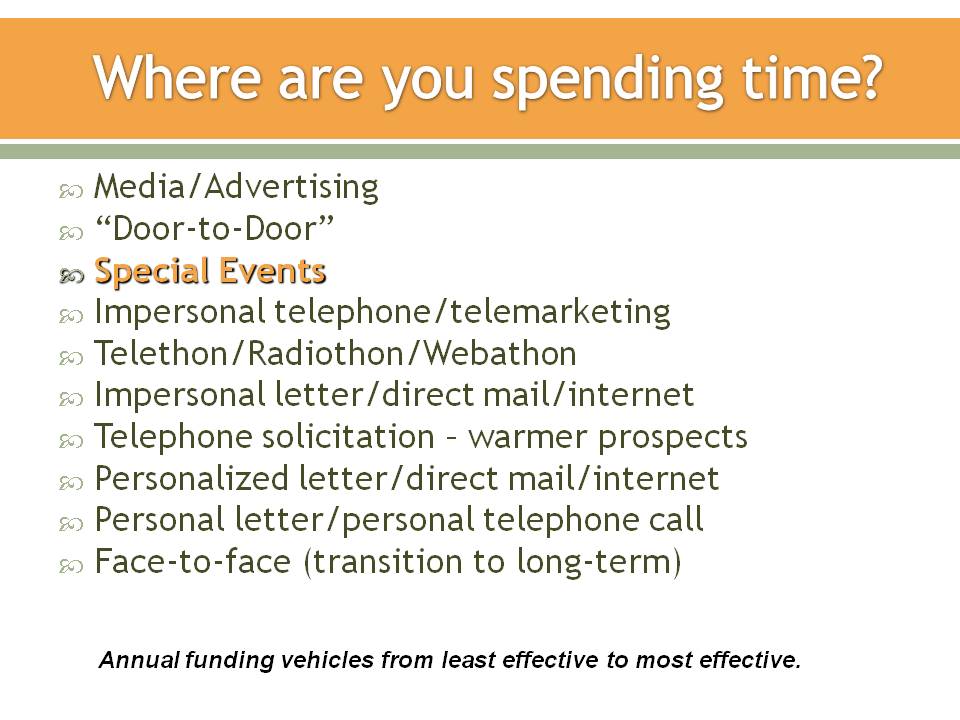
These two people show us the imperative of doing things differently. Even if your organization is not ready to launch a major gifts program or cultivate planned giving, you can still work in the most effective areas of annual fundraising – face-to-face conversations. These are the exact skills you will use in gaining the gifts that are 20x-25x larger than the annual gifts when you are ready to venture into planned giving.
Efficiency is doing the job right. Effectiveness is doing the right job. – Rick Gettle
Review the list – are you doing the right job to accomplish the goal of more revenue?
So, the first step for even small organizations is to concentrate on raising more annual funds in less time and with less effort. In other words, be more productive and build more solid relationships that will lead to more substantial gifts. Educate yourselves about people (in general and individually) and learn about all the different ways philanthropy can meet their needs.
It is a simple plan, but it is not easy. It takes an individual commitment to improve personal performance as well as a willingness to talk with people in private conversations. It takes energy to leave the office and press the flesh and ask for referrals. It takes courage to risk doing something that you have never done before – courage to persuade your boss and your board that it makes sense . . .
Action List to improve performance and increase revenue:
- Define exactly what you want – write out your specific goals every day and link your schedule to those goals
- Educate yourself every week on something new to help reach those goals
- Surround yourself with like-minded people that can give you fresh ideas and inspiration toward achieving your goals.
- Re-design your strategy and priorities to include more one-to-one conversations
- Review your donor lists and begin learning MORE about each individual
- Reach out to estate attorneys, financial professionals, CPAs and life insurance professionals.
5. Find an accountability partner to help you and whom you can help
Laura Miller has a Mastermind program that will help you accomplish this Action List.
Contact her at philanthropyplus@hotmail.com or 614-915-4324.
Radio Program for This Week

There was no show this week – your host, Laura Anne Miller, is also a busy mom with 5 children, and today was the first day of school! Listen to an archived episode and join us NEXT WEDNESDAY August 31 at 2pm. Thanks!
Donations of Assets Convert to $$$
Australia University is selling a donated Picasso at auction to raise cash for a research facility.
We are doing the same thing for Motts Military Museum in Groveport, OH – they have received donations of physical assets and are converting them to cash for exhibit expansion and operations. The most interesting is an engine from a Vietnam-era helicopter.
You don’t have to be fabulously wealthy or possess a lot of expensive antiques to create an auction that benefits your favorite non-profits. Many types of personal property can be donated to an organization and auctioned. If you are moving/downsizing, have a small business with inventory and materials, or just want to get cleaned out and organized, then you are a candidate for the “auction-donation” method of giving.
Timing is everything – as far as tax deductions and maximizing the cash for the organization. An “auction-donation” can follow different paths, depending upon what is best for the donor and his/her philanthropic goals. See the following slide show:Converting Non-Cash Assets
The benefits are 3-fold:
- You simplify your life
- You receive a tax deduction**
- The organization receives cash
** Tax deduction amount varies based on the timing of the donation and your personal circumstances. The material presented here is for information purposes ONLY and is not intended nor should be consider tax advice. Consult your tax and financial advisors before making donations.
Raise significant funds in 2011 – and BEYOND
Use the IRA Qualified Charitable Distribution in a special way – you don’t have to sacrifice current donations to build a long-term planned giving progam for your organization!
Take a look at this presentation on Slideshare.net – then contact Laura for more information.
A New Age for Ohio’s Oldest Non-Profit
Annual Giving + Capital Campaign + Planned Giving = Strategic Investment in the Future
 The Columbus Maennerchor is moving forward with a new vision that is rooted in its past. The 162-year old organization recently sold the building that they occupied as a social club, rehearsal hall, and public banquet/restaurant facility. With this sale, the Maennerchor will move into a smaller space next door and focus on bringing German folk singing and other folk culture programs to the public.
“The young people are interested in a different style of socializing,” commented Werner Niehaus, President. “They do not want to be tied to one place for dining out or feel obligated to participate in only one type of family activity. They have many more choices.” Therefore, the Maennerchor membership will focus on programs related to singing, music, language and the other folk cultural activities. While the main themes will be German culture, they are expanding the scope to include other European and world cultutres that are represented in the Columbus area. In this way, the Maennerchor will provide the wider community more opportunities to learn about the cultures that have made such a significant contribution to the character of Columbus’ heritage.
The first phase of this new focus is to rennovate the historic building on South High Street that the Columbus Maennerchor will still occupy. They want to include young people in the process, so the Maennerchor is actively investigating partnerships with local educational programs to design and construct the space. Funding will come from a modest capital campaign and grants.
But the fundraising does not stop there. The Columbus Maennerchor intends to preserve and promote the “living memory” of German and other cultures that have made Columbus the wonderfully diverse place it is today. Therefore, they are setting up an on-going funding program that includes not only annual giving but planned giving as well. The best part of this program is that it will be implemented almost entirely by the volunteer efforts of the membership. With guidance and coaching in the PhilanthropyPlus system, the members can network and make connections that will ensure the mission of the Columbus Maennerchor is alive in perpetuity. All three activities will be worked on SIMULTANEOUSLY: capital campaign, annual funding of programs, planned giving.
The Columbus Maennerchor was begun in 1848 by 12 men who wanted to get together and sing German songs. Today, it is 300 members strong, many of them participating in one of the singing groups that include people from the ages of 7 up to 92! By connecting to the past and making strategic, intentional plans for the future, the Maennerchor will be here to entertain and enrich our lives for many generations.

- The old Cols Maennerchor resturant and hall

(FYI – the Columbus Maennerchor restaurant is still open to the public until this summer.)
Getting their attention
How are you using social media to promote your organization? Are you caught up in frenetic activity or purposeful content when using social media? Take a look at this video, and let me know what you think – pay particular attention at the 1:06 minute mark.
Leadership at Gettysburg
Inaction is not an option
-Every organization desires a leader like General John Buford. On the afternoon of June 30, 1863, Buford arrived on the scene just outside Gettysburg. After assessing the situation, he made a critical decision that led to a Union victory and probably changed the course of American History. Take a look at the video as we remember those that fought at the Battle of Gettysburg.
The Dignity of Work
 One of my clients, the MCS/TOUCH program was recently awarded a substantial grant to implement a program of community development. It is a summer work program for young people – helping them take their lives to a new level of growth and exploration. An essential part of this program, and of all the services at MCS/TOUCH, is to provide employment opportunities. We have an enormous list of “Pathway Partners” – employers who are willing to give people the opportunity to learn about the positive benefits of a good day’s work. They are small businesses and non-profit organizations that hire the participants and give them the gift of dignity. These business people are interested in making a profit, for certain. However, they are also intensely committed to making an investment in the community. Thank you to all the Pathway Partners! They are making it possible for people of all backgrounds to get to the level where they are net contributors and do not have to be dependent upon “charity” for their survival. . . .
If you would like to learn how to become a Pathway Partner and jump to the highest level of the Golden Ladder, contact Laura Miller – 614.915.4324 or lmiller@nfpcoaching.com . . . The summer works! program fully compensates the participant (up to 120 hours). See: Pathway Partners wordpress blog
If you are a non-profit and would like to learn how we were successful in this grant process, contact Laura Miller at the phone/email above. As a reminder, here is the Golden Ladder of Philanthropy:
The Golden Ladder of Philanthropy
By Maimonides
(From Lowest Level to Highest Level)
1. To give reluctantly, the gift of the hand, but not of the heart.
2. To give cheerfully, but not in proportion to need.
3. To give cheerfully and proportionately, but not until solicited.
4. To give cheerfully, proportionately, and unsolicited, but to put the gift into the poor person’s hand, thus creating shame.
5. To give in such a way that the distressed may know their benefactor, without being known to him or her.
6. To know the objects of our bounty, but remain unknown to them.
7. To give so that the benefactor may not know those whom he has relieved, and they shall not know him.
8. To prevent poverty by teaching a trade, setting a person up in business, or in some other way preventing the need of charity.
About the Author – Maimonides (1135 -1204)
Jewish rabbi, physician, Talmudic scholar and philosopher in Egypt.
 Unleashed Abundance