Blog Archives
Confidence & Optimism at All-Time Low
I saw this on MSN.com today – from an NBC/Wall Street Journal Poll:
. . . 61 % say the United States is headed in the wrong direction; 65 % believe the nation is in a state of decline; and 66 % say they’re not confident that life for their children’s generation will be better than it is now.
In addition, Americans are deeply pessimistic about the state of the economy. Only 26 % think the economy will improve in the next 12 months (which is down 14 points from the previous poll), and just 26 % believe their wages will increase in the next year.
Confidence in key U.S. institutions is also incredibly low: 18 % have confidence in the federal government; 13 % have confidence in the news media; 12 % have confidence in large corporations; 10 % have confidence in the financial industry; and only 9 % have confidence in Congress. The numbers for the media and Congress are the lowest for those institutions in the entire history of the poll.
What are the implications for philanthropy?
If you are a non-profit, what does this poll tell you? What do you have to do differently? What does it mean for the future of your organization and those you serve?
If you are a philanthropist (donor) – of ANY size net worth – what are the implications for you? How do you feel about the future of the American/World economy? How do you feel about your family’s future? What would you like to do about it?
SEEKING: non-profits that you know and love that are in looking to improve their revenue streams. Contact Laura Anne Miller, 614.915.4324, lmiller@nfpcoaching.com today.
Full story on msn.com http://www.msnbc.msn.com/id/38996574/ns/politics/?GT1=43001
$41,000,000,000,000
That’s read: $41 trillion
What is this number?
It is the estimated amount of wealth transfer from one generation to the another in the next 50 years. Most non-profits are salivating at that figure -anticipating that it is going to come to them. But most of these organizations are kidding themselves. Why? Because they are not planning to channel those funds to the social sector – they are pinning all their hopes on it just coming to them because people realize they are in pursuit of a noble cause.
In reality, most non-profits are so focused on events, direct mail and corporate sponsorships (i.e., annual fundraising) that they are losing sight of the fact that this $41 trillion will slip past them and go right to federal and state coffers. They are so concerned about their short-term urgency that they are setting themselves up to be in “urgent” mode in perpetuity.
MYTH: Your current individual donors are so in love with your organization that they will just naturally leave you their wealth.
REALITY:
- Most donors are not aware of philanthropic vehicles beyond a will bequest – which in many ways is the least beneficial of all planned giving techniques (for them, their families, and the non-profits they remember in their wills).
- Will bequests often are seen as a “windfall” to the non-profit organization. It comes as a 1-time surprise. There is no systematic, purposeful plan to include legacy funds in the long-term revenue mix.
A well-organized planned giving program can keep the doors open now and in the future. It is not an either/or situation. One of the key features of PhilanthropyPlus ™ is that it is pays for itself right away and along the way. It builds a steadily rising stream of income that is predictable and based in relationships – not annual transactions. PhilanthropyPlus ™ takes a shift in processes in fundraising and development; but it is one that can be implemented in less time, at lower cost, and with less frustration than you may think.
Check out the Interpretations Advisor Group website to learn more and to contact Laura Anne Miller to discuss how PhilanthropyPlus ™ can be a planned strategy for growth.
Golden Ladder of Giving
Met with Steve Friece this week. He is Executive Director of Crossroads Community Development. He is on the cutting edge of human services, especially to the “poor”. We had an excellent discussion on the difference between “charity” and “philanthropy”. Charity is for emergencies and crises. It often treats symptoms w/out looking deeper to the true causes of the individual recipient’s situation.
For Steve, and for me, Philanthropy is a higher form of engagement – the purpose is to enhance the lives of others so that they are transformed from “recipient” to “participant” in society. The recognition of each individual’s dignity and showing genuine, authentic love of those people are at the heart of Philanthropy. It is a long-term proposition that focuses on providing the receipient tools, knowledge, understanding, and even tough love to so that he/she never has to go begging again.
Take a look at this commonly known set of “giving” levels (below). In this day and age, a non-profit’s donors and potential donors can fall into all of these categories. Those that are on the highest level of giving are interested in making a social investment, not just writing a check to “feel good”. Because those donors are looking to make a fundamental impact on the community, their gifts are often the most significant in terms of amount and on-going commitment. That is why these posts have focused on the paradigm shift in giving.
As an organization “moves” donors up that ladder, they are alble to fulfill their mission in a more significant way. They can build capacity and make true change in the conditions of those they serve. In the end, both the recipient of the services and the donors benefit. This is accomplished through a purposeful, intentional planned giving program.
Even small organizations can benefit from having a planned giving program that funds a long-term sustainable organization that enhances all lives and makes connections between people in the community. For more information, contact Laura to discuss how you can accomplish this.
After reading this list – please post comments. Want to hear what you have to say about Charity and Philanthropy.
The Golden Ladder of Giving
By Maimonides
1. To give reluctantly, the gift of the hand, but not of the heart.
2. To give cheerfully, but not in proportion to need.
3. To give cheerfully and proportionately, but not until solicited.
4. To give cheerfully, proportionately, and unsolicited, but to put the gift into the poor person’s hand, thus creating shame.
5. To give in such a way that the distressed may know their benefactor, without being known to him or her.
6. To know the objects of our bounty, but remain unknown to them.
7. To give so that the benefactor may not know those whom he has relieved, and they shall not know him.
8. To prevent poverty by teaching a trade, setting a person up in business, or in some other way preventing the need of charity.
About the Author – Maimonides (1135 -1204)
During the Middle Ages he was a Jewish rabbi, physician and philosopher in Egypt.
A Single Grain of Rice
Let this simple folk tale inspire you . . . . Contact Us to learn how to experience extraordinary growth through Referrals and Network Fundraising. It goes beyond “social media” and related phenomena – our programs are about building commitments.
A SINGLE GRAIN OF RICE
a mathematical folktale by Demi
Long ago in India, there lived a raja who believed he was wise and fair, as a raja should be. The people in his province were rice farmers. The raja decreed that everyone must give nearly all of their rice to him. “I will store the rice safely,” the raja promised the people, “so that in time of famine, everyone will have rice to eat, and no one will go hungry.” Each year, the raja’s rice collectors gathered nearly all of the people’s rice and carried it away to the royal storehouses.
For many years, the rice grew well. The people gave nearly all of their rice to the raja, and the storehouses were always full. But the people were left with only enough rice to get by. Then one year the rice grew badly and there was famine and hunger. The people had no rice to give to the raja, and they had no rice to eat. The raja’s ministers implored him, “Your highness, let us open the royal storehouses and give the rice to the people, as you promised.” “No!” cried the raja. How do I know how long the famine will last? I must have the rice for myself. Promise or no promise, a raja must not go hungry!”
Time went on, and the people grew more and more hungry. But the raja would not give out the rice. One day, the raja ordered a feast for himself and his court–as, it seemed to him, a raja should now and then, even when there is famine. A servant led an elephant from a royal storehouse to the palace, carrying two full baskets of rice. A village girl named Rani saw that a trickle of rice was falling from one of the baskets. Quickly she jumped up and walked along beside the elephant, catching the falling rice in her skirt. She was clever, and she began to make a plan.
At the palace, a guard cried, “Halt, thief! Where are you going with that rice?”
“I am not a thief,” Rani replied. “This rice fell from one of the baskets, and I am returning it now to the raja.”
When the raja heard about Rani’s good deed, he asked his ministers to bring her before him.
“I wish to reward you for returning what belongs to me,” the raja said to Rani. “Ask me for anything, and you shall have it.”
“Your highness,” said Rani, “I do not deserve any reward at all. But if you wish, you may give me one grain of rice.”
“Only one grain of rice?” exclaimed the raja. “Surely you will allow me to reward you more plentifully, as a raja should.”
“Very well,” said Rani. “If it pleased Your Highness, you may reward me in this way. Today, you will give me a single grain of rice. Then, each day for thirty days you will give me double the rice you gave me the day before. Thus, tomorrow you will give me two grains of rice, the next day four grains of rice, and so on for thirty days.”
“This seems to be a modest reward,” said the raja. “But you shall have it.”
And Rani was presented with a single grain of rice.
The next day, Rani was presented with two grains of rice.
And the following day, Rani was presented with four grains of rice.
On the ninth day, Rani was presented with 256 grains of rice. She had received in all 511 grains of rice, enough for only a small handful. “This girl is honest, but not very clever,” thought the raja. “She would have gained more rice by keeping what fell into her skirt!”
On the twelfth day, Rani received 2048 grains of rice, about four handfuls.
On the thirteenth day, she received 4096 grains of rice, enough to fill a bowl.
On the sixteenth day, Rani was presented with a bag containing thirty-two thousand, seven hundred and sixty-eight grains of rice. All together she had enough rice for two bags. “This doubling up adds up to more rice than I expected” thought the raja. “But surely her reward won’t amount to much more.”
On the twentieth day, Rani was presented with sixteen more bags filled with rice.
On the twenty-first day, she received one million, forty-eight thousand, five hundred and seventy-six (1,048,576) grains of rice, enough to fill a basket.
On the twenty-fourth day, Rani was presented with eight million, three hundred and eighty-eight thousand, six hundred and eight grains of rice–enough to fill eight baskets, which were carried to her by eight royal deer.
On the twenty-seventh day, thirty-two brahma bulls were needed to deliver sixty-four baskets of rice. The raja was deeply troubled. “One grain of rice has grown very great indeed,” he thought. “But I shall fulfill the reward to the end, as a raja should.”
On the twenty-ninth day, Rani was presented with the contents of two royal storehouses.
On the thirtieth and final day, two hundred and fifty-six elephants crossed the province, carrying the contents of the last four royal storehouses–Five hundred and thirty-six million, eight hundred and seventy thousand, nine hundred and twelve grains of rice.
All together, Rani had received more than one billion grains of rice. The raja had no more rice to give. “And what will you do with this rice,” asked the raja with a sigh, “now that I have none?”
“I shall give it to all the hungry people,” said Rani, “and I shall leave a basket of rice for you, too, if you promise from now on to take only as much rice as you need.”
“I promise,” said the raja. And for the rest of his days, the raja was truly wise and just, as a raja should be.
______
Interpretations Consulting has two programs as part of PhilanthropyPlus ™ that build your network of ambassadors to advocate for your organization.
Ask about :
The Ultimate Gift Century Club
Business Mastermind Groups
2 systems that pay for themselves right away and along the way – financing long-term sustainability . . . laura@nfpcoaching.com or 614.915.4324
You can make only so many budget cuts before you disappear.
Non-profits with an active planned giving program are more stable than those without one.
Last year, when the recession really hit, most non-profits tightened their belts. Then they went on a binge of events, galas, direct mail appeals and “tin cup” campaigns (the least effective methods of fundraising, by the way.)
Well, revenues for most non-profits were down anywhere from 10% – 25%, or worse. If an organization made budget cuts last year, there is no more “fat” left to trim. They could shut their doors if they don’t find a way to raise more revenue, and raise it now. It may seem like a hopeless downward spiral, fraught with stress and confusion. So what is a non-profit to do?
A system of sincere, values-based, face-to-face encounters with donors and potential donors is the key to your success, both now and in the future. It will take a plan that includes not only annual fundraising but also planned giving.
The problem is that planned giving is complex. It is a mystery to most development professionals, let alone board members, executive directors and donors. Further, it takes a very long time to “convert” the donation – an average of 18 months to 3 years. Therefore, very few organizations have truly meaningful and effective planned giving programs.
However, the average size of a planned gift is 20-25 times larger than the average annual gift, including corporate sponsorships. In addition, organizations that have an established planned giving program are weathering the recession storm better than the average non-profit.
An investment in a planned giving program does not have to be delayed. With a fresh approach, such as PhilanthropyPlus ™, my clients can raise money now AND planet seeds for that future growth and security. Any plan to get a planned giving program up and running should include:
- CLEAR, values-based, compelling case for support
- Education & Professional Development for the non-profit leaders
- Board engagement and education
- Ambassadorship program
- A “sales” program of genuine relationship cultivation & referrals
It takes time, a lot of authentic character development, focus on service and discipline. In the process, you will have to get out of your “cave” and into circulation, which is very difficult for most non-profit professionals. It is not easy, like an event or a direct mail campaign, but it is simple.
For more information on how your organization can have PhilanthropyPlus ™ work for you, see our website and Laura’s full LinkedIn profile.
New Attitudes & Behaviors in Philanthropy
Check out this brief slide show on the paradigm shift in giving and some innovative ways to adapt.
This is for non-profit organizations and businesses that want to make philanthropy part of their business plan.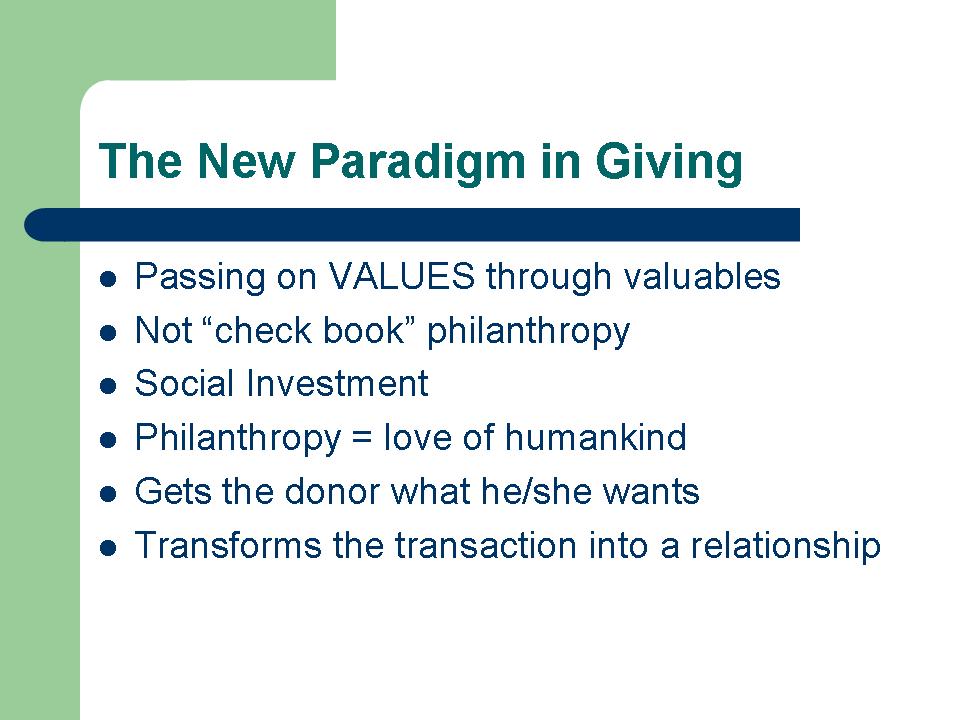
Paradigm Shift
The Paradigm has already shifted –
It is clear that for non-profits to succeed and make a difference in our world, some attitudes, behaviors, and methods have to change immediately. We do not want to repeat 2009.
The Chronicle of Philanthropy reported last autumn that 74% of donors surveyed said they were waiting for the economy to improve before they return to higher levels of philanthropic giving. And things don’t look as if they are going to become better for a while.
So, you wait and wait and wait.
But can you really afford to wait for outside circumstances to change?
To put a finer point on it –
- Can those you serve, or could serve, afford for you to wait until you feel ready?
- What is the cost to humankind for your delay?
- Who suffers while you hesitate or keep “trying” the same old fundraising and management methods that have ceased to work?
It is obvious that you will have to be proactive in your innovations in 2010. But where do you start? What is the process of finding and creating those innovations? That’s why I have created PhilanthropyPlus ™ . It is a turn-key system that allows non-profits to operate in the most effective areas of management and fundraising. It provides for immediate improvement while planting the seeds for long-term sustainability.
 Unleashed Abundance